
Dermaroller & Dermapen


Dermaroller or Dermapen - which is better for your skin?
Microneedling treatments with a dermaroller or dermapen are very much in vogue. For this reason, it is good to know what the similarities and differences are and what the advantages and disadvantages are. Both dermarollers and dermapen are devices that are used for microneedling treatments.
Microneedling uses many tiny needles to create tiny puncture channels in the skin. These micro-injuries to the skin stimulate blood circulation, ensure the formation of tiny new blood vessels that optimise microcirculation and improve the absorption of active ingredients from the microneedling serums used. In addition, not only is the formation of new cells stimulated, but also the production of the body's own hyaluronic acid, collagen and elastin.
All of these processes mean that microneedling can be used for anti-ageing treatments as well as effectively helping many people with major problems.
The areas of application of microneedling include, for example
- Fine lines and wrinkles
- Oily, greasy skin
- Dull, lifeless skin
- Sagging skin
- Stretch marks
- Cellulite
- Scars, especially acne scars
- Pigment spots
- Photo-ageing
- Large pores
- Redness
- Hair loss and reduced hair growth
- Reduced beard growth
What is a dermaroller and how does it work?
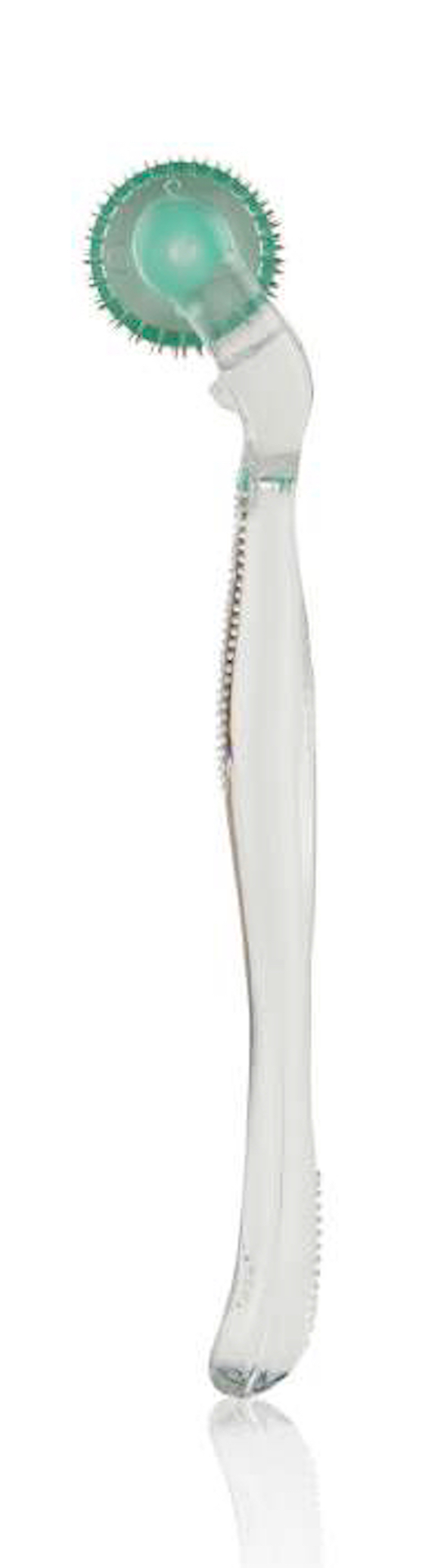
As mentioned above, the dermaroller is a microneedling device consisting of a handle with a movable roller at the end. This movable roller has a number of tiny needles of the same length attached to it.
This roller is rolled over the skin with the handle, whereby the needles attached to the roller make tiny puncture channels in the skin. The best way to visualise this is to look at the following picture of a dermaroller.
What is a Dermapen and how does it work?
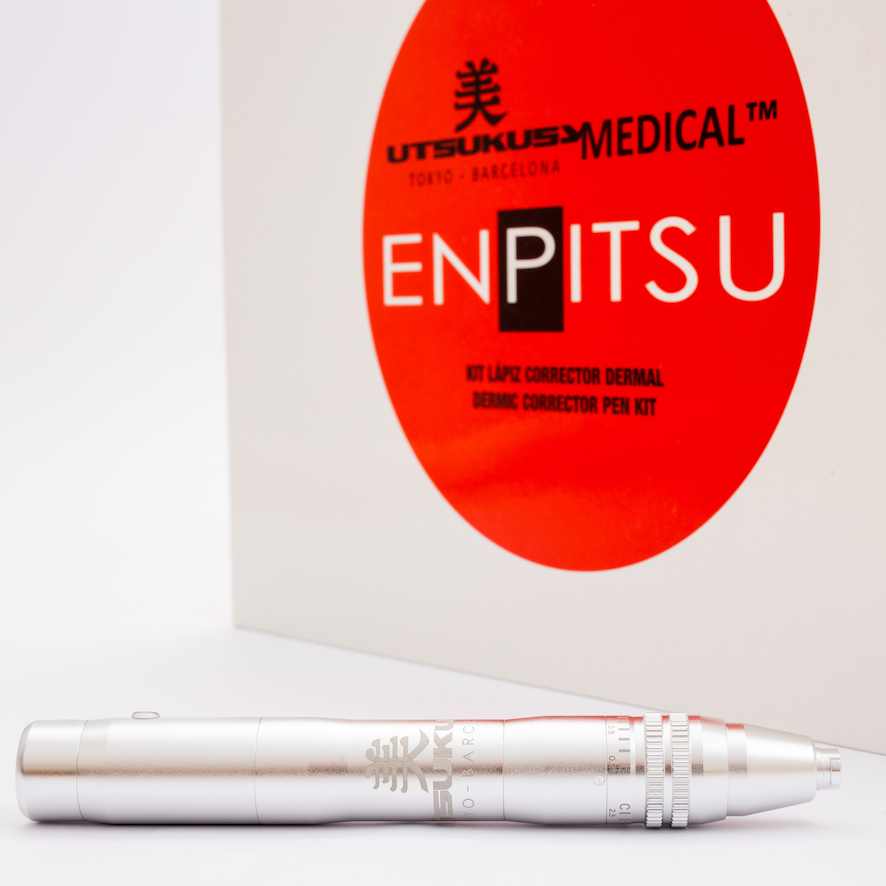
The Dermapen, on the other hand, is an electric or battery-powered microneedling device. The Dermapen looks like an oversized pen with a small attachment at the end. This attachment is called a needle head or pin cushion. The needle head is usually fitted with 12 or 36 tiny needles. However, the number of needles can vary depending on the manufacturer. In addition to the needle heads fitted with needles, there are also so-called nano needle heads, which function more like a stamp. But more on this later.
The electric drive moves the needles in the needle head up and down. The speed at which the needles move can be adjusted on many devices. The stitch depth of the needles can also be adjusted on the device.
Enpitsu Dermapen from Utsukusy Cosmetics
Dermaroller vs Dermapen - differences and similarities
What the Dermaroller and Dermapen have in common is of course that both devices are used in microneedling treatments to create puncture channels in the skin. However, they also differ in many ways. Let's take a closer look at some aspects.
Hygiene and cleaning
The topic of hygiene and working as sterilely as possible are very important in microneedling treatments. This applies not only to the microneedling device used, but also to all processes and procedures and materials used, such as sterile microneedling serums.
A dermaroller may only ever be used by the same person and must be thoroughly cleaned and disinfected before and after each application. Very good knowledge of the cleaning steps and the cleaning agents to be used is essential if the use of dermarollers is not to lead to infection. If you want to needle the whole face, possibly also the neck and décolleté, then you will not be able to manage with a dermaroller as you will need different needle lengths.
With a Dermapen, on the other hand, this is much easier and safer, as the used and therefore contaminated needle head is simply disposed of after the treatment. A new sterile-packed needle head is used for each treatment and for each person. The Dermapen handle should still be cleaned and disinfected before and after each treatment.
Stitch depth
The penetration depth of the needles is fixed for each Dermaroller, which means that the penetration depth can only be changed during a treatment by using a different Dermaroller with the corresponding needle length. If you need a shallower stitch depth for the sensitive skin around the eyes or for the lips, you need to have several dermarollers available and ready to use in order to treat all regions with the correct stitch depth.
The advantage of the Dermapen here is clearly that the stitch depth can be variably adjusted on the device. The Dermapen does not even need to be switched off for this. The needle head used does not need to be changed either.
Number of stitch channels
The number of properly placed stitch channels is of course important for the success of the treatment. The number of stitch channels is created with the dermaroller by the number of needles on the roller and the frequency with which you roll over the treated skin area.
A good dermapen, on the other hand, performs several thousand up and down movements (strokes) per minute. With many devices, such as the Enpitsu Dermapen from Utsukusy Cosmetics, the speed can be adjusted via different power levels. It is obvious that more stitch channels can be produced with a Dermapen than with a dermaroller, at least in the same amount of time.
Precision of the stitch channels
The rolling motion with which the dermaroller is rolled over the skin can lead to slight "fraying" of the stitch channels. This is particularly the case if the needles on the dermaroller are of poor quality or the dermaroller has been used too often and not changed.
The precision of the puncture channels is generally much better with Dermapen, as the needles of the Dermapen penetrate the skin vertically. For us, this is also a clear plus in favour of the Dermapen.
Areas of application
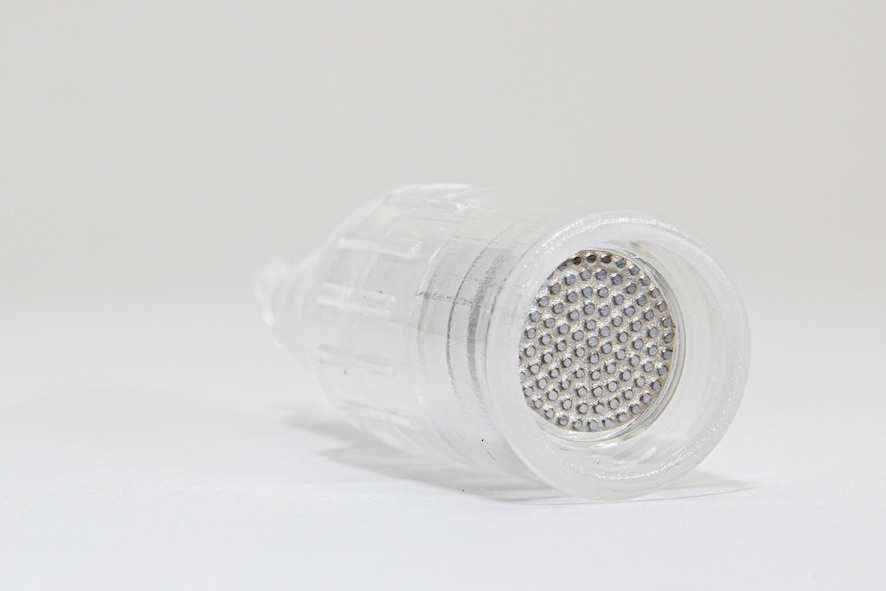
As already mentioned above, in addition to the needle heads with 12 or 36 needles, there are also so-called nano needle heads. The term "needle head" is misleading, as these are not needles at all, but a kind of "plunger" that sits in place of the needles. These nano-needle heads can be used, for example, to treat particularly sensitive areas of skin around the eyes or lips with a Dermapen. This is particularly helpful for inexperienced users, although the effect is not comparable to that of using "real" needles.
Nano needle head for Enpitsu Dermapen from Utsukusy Cosmetics
The nano needle heads are nevertheless ideal for "tapping" active ingredients into the skin. For example, the intensity of a peeling can be significantly increased if the peeling liquid is "tapped" into the skin. However, this should only be understood as an indication for professional users.
These application options are completely absent with a dermaroller.
On the other hand, the dermaroller scores with its larger contact surface when treating larger areas of skin, as is often the case with cellulite treatment using microneedling, for example.
Conclusion
It is clear that although we sell Dermarollers and Dermapens, we favour the Dermapen, not because it is more expensive, but simply because it is the better microneedling device.
Note:
The products offered here are exclusively cosmetic products within the meaning of the EU Cosmetics Regulation (Regulation (EC) No. 1223/2009). They are not classified as medical devices and are not intended to diagnose, treat, cure or prevent any disease.
If the product description refers to "sterile" products, this refers exclusively to the sterile packaging and not to the fact that the product itself is certified as a sterile medical device.
Certain products are expressly intended only for commercial use by professionally trained personnel (e.g. beauticians, alternative practitioners, studios). These products must not be used without appropriate expertise. Please observe the respective instructions in the product description.
The effects and results described refer to cosmetic care and do not replace medical or alternative practitioner treatment. In the case of existing skin diseases or health complaints, we recommend seeking medical advice before use.
All instructions for use, blog posts and product descriptions are for information purposes only and do not constitute medical advice. Use is at your own responsibility and risk.